

- HOME
- Sustainability
- Materiality 1
Reduce the environmental impact of our business activities - TNFD-Aligned Disclosure
TNFD-Aligned Disclosure
Introduction
The PPIH Group supports the daily lives of local communities and provides enjoyable shopping experiences, guided by the corporate principle of "The Customer Matters Most."
The PPIH Group is committed to resolving important environmental and social issues (materiality) through our core business of general retailing. We aim to achieve both the realization of a sustainable society and the enhancement of medium- to long-term corporate value through ongoing dialogue with stakeholders.
In an era of rapid change, the PPIH Group has strengthened its response to ESG (Environmental, Social and Governance) issues under its medium- to long-term management plan, "Visionary 2025/2030." Under its long-term management plan, "Double Impact 2035," we continue to advance these initiatives, with the aim of simultaneously realizing a sustainable society and enhancing corporate value.
In the nature-related domain, the PPIH Group has identified key priority areas, including "addressing climate change," "sustainable product procurement and responsible sales with consideration for human rights and the environment," and "addressing social and environmental issues across the supply chain," and advancing a range of related initiatives. In accordance with our "Basic Sustainability Policy," the PPIH Group is committed to addressing environmental and social challenges through our core business as a general retail operator. To operationalize this commitment, we have established our "Environmental Policy," "Human Rights Policy," "Sustainable Procurement Policy," and "Supply Chain Code of Conduct." Through these frameworks, we aim to reduce our environmental footprint by incorporating sustainability --including climate change, prevention of environmental pollution, and impacts on biodiversity-- while placing strong emphasis on respect for human rights throughout the supply chain.

In recent years, alongside climate change, nature-related issues such as biodiversity loss, land-use change, and water resources have gained increasing importance in ensuring business continuity. As a general retailer handling a wide range of products, including food, daily necessities, and apparel, and operating numerous stores, the PPIH Group both depends extensively on nature capital and generates impacts on nature across our value chain, from raw material sourcing to product supply and store operations. In particular, as strengthening of private brand (PB)/OEM products and the food segment is positioned as a core component of the PPIH Group's growth strategy, the relationship with nature in production and sourcing regions of the raw materials is becoming increasingly material from a sustainability management perspective. Based on this recognition, the PPIH Group, with reference to the TNFD (Taskforce on Nature-related Financial Disclosures) framework, identified and assessed its dependencies on and impacts on nature arising from our business activities. We also advanced the analysis of nature-related risks and opportunities, while strengthening our risk management practices. Positioning the enhancement of corporate brand value, as set out in our long-term management plan "Double Impact 2035," as a key pillar of our growth strategy, the PPIH Group promotes information disclosure and engages proactively with stakeholders, thereby contributing to the realization of a sustainable society.
The PPIH Group continues to uphold its corporate philosophy and action guidelines set forth in "The Source," and remains committed to pursuing the dual objective of contributing to society through our business activities while achieving sustainable growth.
General requirements
Application of materiality
This disclosure applies a double materiality approach, considering both:
-the financial impacts of nature on the PPIH Group's business activities (financial materiality), and
-the impacts of the PPIH Group's business activities on nature (impact materiality).
Scope of disclosure
Within the PPIH Group's operations, the scope of this disclosure is defined as the domestic retail business, which represents approximately 80% of our consolidated revenue.
The assessment scope covers:
-direct operations (in-store retail activities), and
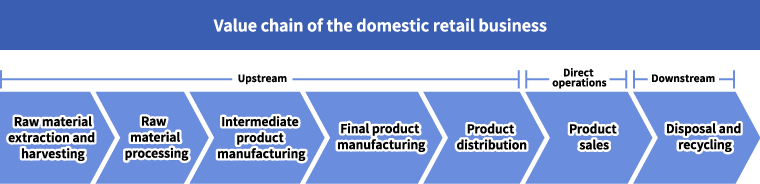
-the value chain of major products handled in domestic stores, from raw material sourcing through to disposal and recycling.
Within this scope, we have assessed our dependencies and impacts on nature. Based on these assessments, we identified and disclose nature-related risks and opportunities associated with in-store retail operations, as well as those related to product value chains--particularly in upstream processes such as raw material sourcing and extraction, where dependencies and impacts have been identified as significant.
Location of nature-related issues
A location-based analysis was conducted across 666 domestic retail store locations*1, considering the surrounding natural environment of each store. Given the nature of retail operations, our direct dependencies and impacts on nature capital at store level were assessed as relatively limited. A screening analysis was conducted based on spatial proximity to Protected Areas (PAs)*2 and Key Biodiversity Areas (KBAs)*3. Through this analysis, priority locations for management were identified, including those with higher potential exposure to nature-related risks and impacts.
*1 As of January 28, 2026, when the LEAP assessment was commenced.
*2 PA:Protected Area. Areas are legally designated and managed for conservation purposes, such as national parks and wildlife reserves.
*3 KBA:Key Biodiversity Area. Sites identified as contributing significantly to the global persistence of biodiversity.
Integration with other sustainability-related disclosures
The PPIH Group has advanced scenario analysis and disclosures in line with the Task Force on Climate-related Financial Disclosures (TCFD) since February 2022. Our business activities are supported by the benefits of nature--including soil, water resources, climate conditions, and ecosystems--and are therefore closely linked to nature capital, including climate. Recognizing that climate change and nature capital are interrelated and mutually influential, this disclosure seeks alignment with climate-related disclosures under the TCFD framework. Further integration of TCFD and TNFD disclosures is being considered to enhance the comprehensiveness of our environmental disclosures.
The time horizons considered
At this stage, the assessment does not apply explicit time horizons. The analysis has been conducted primarily based on the operational characteristics and geographical conditions of the PPIH Group's domestic retail business. The incorporation of time horizons is under consideration, taking into account the PPIH Group's long-term management plan, Double Impact 2035.
Engagement with Indigenous Peoples, Local Communities and affected stakeholders
The PPIH Group conducts its business activities as a general retailer while engaging with a wide range of stakeholders, and places strong emphasis on dialogue with customers, business partners, employees, shareholders and investors, as well as local communities and municipalities. In product sourcing, based on the PPIH Group Sustainable Procurement Policy and the PPIH Supply Chain Code of Conduct, human rights and environmental risks are identified and managed through ongoing engagement and monitoring. Grievance mechanisms are in place to address potential adverse human rights impacts, with appropriate investigations and remediation processes implemented as necessary. Retail stores serve as key points of engagement with local communities. The PPIH Group has been promoting engagement with residents and future generations through initiatives such as outreach programs conducted at stores to enhance understanding of environmental conservation activities and environmentally responsible product choices. Education programs related to marine ecosystems and environmental issues are also provided through activities such as aquarium maintenance in collaboration with vocational school students and the operation of mobile aquariums. Through these efforts, the Group seeks to raise awareness and contribute to the reduction of indirect negative impacts on nature associated with consumer behavior.
Sustainability in the supply chain
PPIH Group sustainable procurement policy
PPIH Group Supply Chain Code of Conduct
Ensuring thorough compliance
Growth of future generations
Governance
Supervisory and Execution Structure
With respect to sustainability initiatives, including climate change and nature-related issues, the Sustainability Committee, under the supervision of the Director, Managing Executive Officer and CAO in charge, plans and formulates countermeasures and reflects them in the business activities of Group companies.
The Sustainability Committee reports to the Board of Directors at least once a year on the progress of sustainability initiatives and the status of target achievement.
The Sustainability Committee is chaired by the Executive Officer and Head of the IR Headquarters and meets once a month. It receives reports from subcommittees of subordinate organizations on responses to sustainability issues, including climate change and nature-related issues, and is responsible for target setting, progress management, and monitoring. In addition, the Committee holds regular meetings with external experts with specialized knowledge in sustainability management, including Mr. Hidemi Tomita, Representative Director of the Sustainability Management Institute, to establish a framework that enables initiatives to be advanced from a professional perspective.
Of the 15 Directors, 9 possess skills related to ESG and diversity.
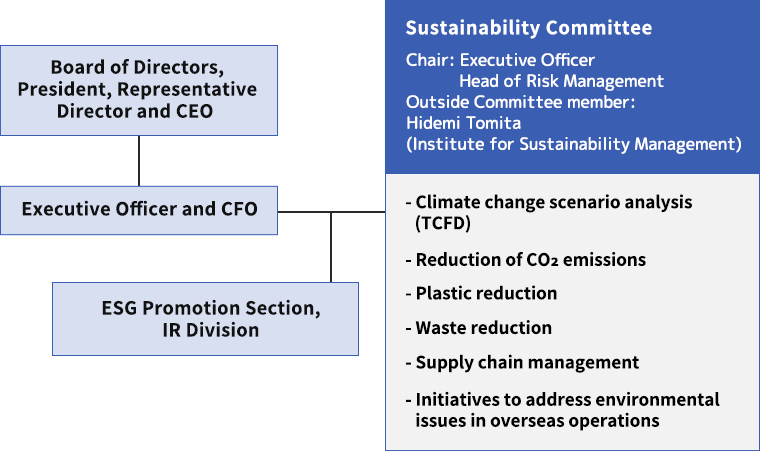
| Organization | Member | Role | Number of Reports and Events |
Fiscal year ending June 26 Main Reports and Deliberations |
|---|---|---|---|---|
| Board of directors |
Director Auditor |
|
Twice a year |
|
| Sustainability Committee |
[Chair] Executive Officer and Head of IR Headquarters [Members] Head of Related Departments (Environmental Measures, Design, Facility Management, Disaster Countermeasures, Crisis Management, Store Compliance, Product Procurement Department, Quality Control, Fair Trade Management, Legal Affairs) [Outside Members] Hidemi Tomita (Representative Director, Sustainability Management Research Institute) |
|
12 times a year (1 time per month) |
|

Human rights policy and stakeholder engagement
The PPIH Group, as a general retail operator, provides a wide range of products and services to customers on a daily basis, while engaging with diverse business partners across our supply chain in Japan and overseas, as well as maintaining a substantial workforce. The PPIH Group places strong emphasis on ongoing dialogue with a broad range of stakeholders, including customers, business partners, employees, shareholders and investors, as well as local communities and municipalities. Through such engagement, we seek to understand stakeholder expectations and concerns and believe that building relationships of trust and collaboration contributes to the realization of a sustainable society.
In light of these business characteristics, we have established the "PPIH Group Human Rights Policy" to promote respect for the human rights of all stakeholders involved in our business activities. The PPIH Group is committed to complying with applicable laws and regulations and to respecting internationally recognized standards, including the Universal Declaration of Human Rights, the International Covenants on Human Rights, the ILO Core Labor Standards, and the UN Guiding Principles on Business and Human Rights.
For the PPIH Group, the supply chain established through product sourcing constitutes the foundation of our business. Accordingly, addressing potential issues related to human rights, labor practices, and occupational health and safety throughout the supply chain is recognized as a key management priority (Materiality 3: Sustainable Sourcing and Responsible Sales). To this end, the Group has established the "PPIH Group Sustainable Procurement Policy" and "PPIH Group Supply Chain Code of Conduct", through which we promote responsible sourcing practices that take human rights and environmental considerations into account across the entire supply chain.
The "Supply Chain Code of Conduct" stipulates requirements relating to respect for human rights, management of occupational health and safety, environmental protection including climate change and biodiversity, and contributions to local communities. The PPIH Group requires business partners involved in private brand (PB) and OEM products, as well as new suppliers, to express their support for the "Sustainable Procurement Policy" and to submit a written pledge to comply with the "Code of Conduct". In addition, the PPIH Group implements due diligence processes, including supplier engagement, self-assessment questionnaires (SAQs) and third-party audits to identify human rights risks across the supply chain. Where issues are identified, the PPIH Group engages in dialogue with relevant partners and provides follow-up support to promote corrective actions, thereby ensuring continuous stakeholder engagement and improvement across the supply chain.
The PPIH Group has established grievance mechanisms, including a dedicated hotline, to receive reports and consultations related to actual or potential adverse human rights impacts. We carefully review all consultations and reports received and, where necessary, undertake appropriate investigations and implement corrective measures. Through these mechanisms, the PPIH Group strives to enhance the effectiveness of our human rights risk management across our business activities and supply chain.
PPIH Group sustainable procurement policy
PPIH Group Supply Chain Code of Conduct
Ensuring thorough compliance
The implementation of the Group's human rights policies, grievance mechanisms, and engagement activities with business partners and other stakeholders is monitored by management, primarily through the Sustainability Committee and the Compliance Committee. Key initiatives and progress are reported to the Board of Directors. The Board oversees the integration of human rights considerations into the Group's business activities and supply chain management and provides direction and guidance on policies and measures as necessary.
Strategy
Scoping
1.Nature-related Dependencies and Impacts
The PPIH Group's business is built on providing a diverse range of products, including food and daily consumer goods, to customers, and inherently depends on nature-derived resources such as agricultural, livestock, and marine products. These resources are supported by the benefits of nature (ecosystem services), including soil, water resources, climate conditions, and ecosystems. In addition, the PPIH Group's value chain encompasses a wide range of activities, from raw material sourcing and logistics to store operations, the provision of products and services, and ultimately disposing and recycling. Across each of these stages, dependencies on nature exist, while impacts on nature also arise through activities such as resource extraction, land use, greenhouse gas emissions, and the generation of wastewater and waste.
Considering these relationships with nature, the PPIH Group recognizes the importance for sustainable business growth is to systematically identify and manage our dependencies and impacts on nature, as well as recognizing the resulting risks and opportunities, across the entire value chain.
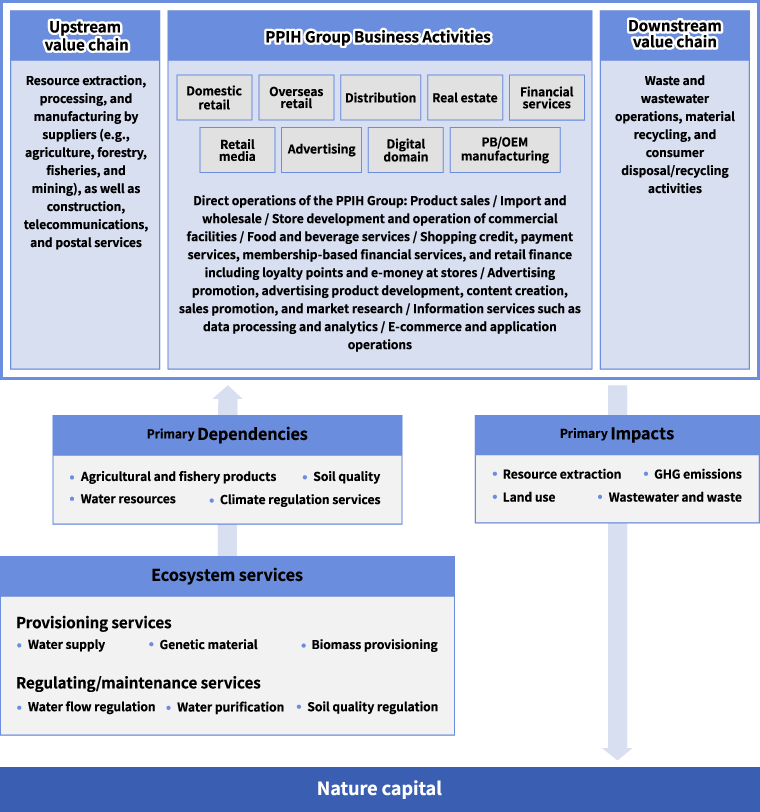
2.Scope of assessment for this disclosure
The Group operates a diverse portfolio of businesses, including domestic and international retail operations, as well as distribution, real estate, and financial services. The scope of this assessment has been defined as the domestic retail business, which is one of the PPIH Group's core businesses. The assessment covers: direct operations, namely in-store sales activities, as well as the value chains of key products sold in domestic stores.
Dependencies and impacts
1.Overview of the analysis process
For the domestic retail business, the PPIH Group identified and assessed nature-related dependencies and impacts by distinguishing between:
-our direct operations, namely in-store sales activities (hereafter referred to as "retail store operations"); and
-the value chains of key products (hereafter referred to as "product value chains").
Key products were classified into seven categories and 34 groups based on raw materials and manufacturing processes. For each category, the corresponding value chain was mapped, and an assessment was conducted using the ENCORE*4 tool. (For further details on the assessment process, please refer to the section "Risk and Impact Management.")
*4 ENCORE:A tool used to assess the materiality of a company's dependencies on and impacts on nature by sector.
| Product categories | Product groups |
|---|---|
| Food and beverages | Two groups: "Food" (including pet food) and "Beverages" |
| Household goods, daily necessities, and pharmaceuticals | Six groups, including paper products such as toilet paper, detergents primarily composed of chemical materials, tableware, and pharmaceuticals |
| Personal items and discretionary goods | Four groups, including watches, accessories, and tobacco |
| Household appliances and metal cookware | Five groups, primarily comprising industrial material-based products, including home appliances and smartphones |
| Sports and leisure goods | Nine groups, primarily comprising chemically based products, including balls and rackets |
| Furniture | Two groups: wooden desks and reclining sofas |
| Clothing and consumer goods | Six groups, including apparel made from natural and synthetic fibers, leather and synthetic leather products, footwear, bags, towels, and curtains and bedding |
2.Assessment results
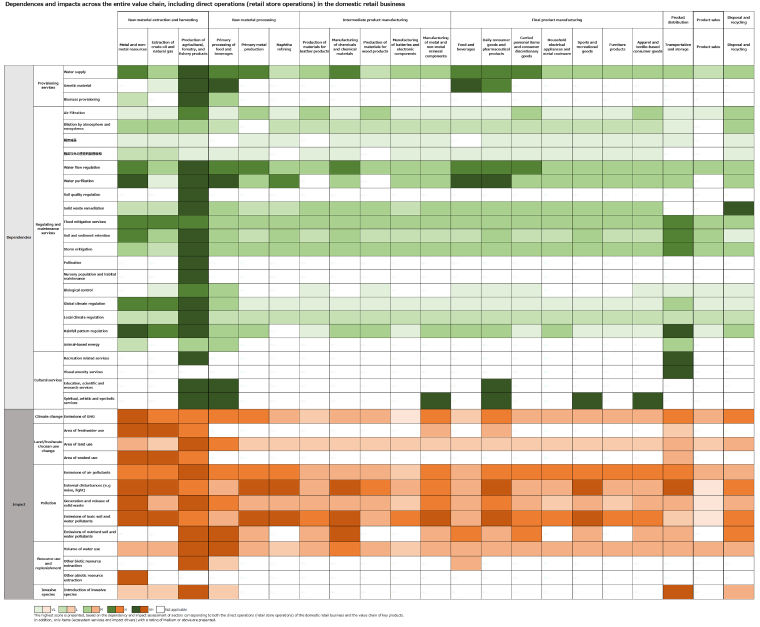
■ Dependencies and impacts across the entire value chain, including direct operations (retail store operations) in the domestic retail business
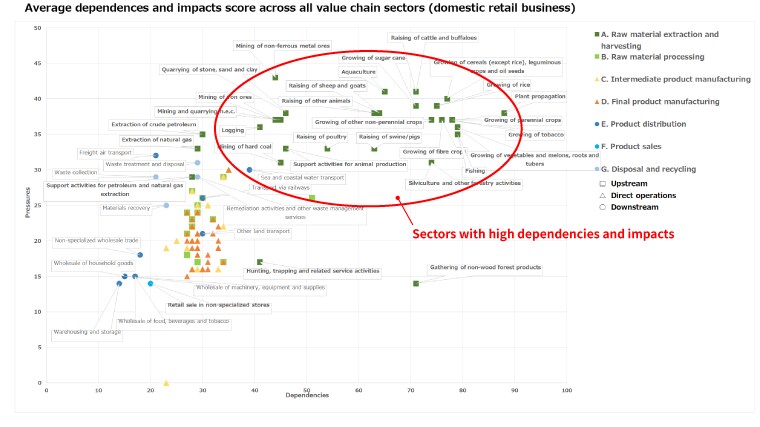
Based on the ENCORE analysis, we found that, within the domestic retail business, dependencies and impacts on nature are most significant in the upstream stages of the product value chains, particularly in raw material extraction and harvesting. In contrast, dependencies and impacts associated with direct operations, namely retail store operations, were assessed as relatively limited.
Significant dependencies and impacts were identified particularly in the following upstream sectors:
- ・Agriculture and forestry: sourcing of raw materials for food and beverages, textiles, and timber used in paper products and furniture.
- ・Mining and quarrying: extraction of non-ferrous and precious metals used in electrical appliances, metal cookware, watches, and accessories, as well as extraction of crude oil and natural gas used as raw materials for household goods, electronic components, fitness and outdoor equipment, and apparel made from synthetic and chemical fibers
■ Dependencies and impacts in retail store operations
While the following dependencies and impacts were identified in retail store operations, it has been confirmed to be relatively limited compared to those across the overall domestic retail business.
| Ecosystem services / Impact driver categories |
Operational risk factors | |
|---|---|---|
| Dependencies | Regulating and maintenance ecosystem services | Dependencies on ecosystem services that mitigate natural disaster impacts, including the water flow regulation functions within river basins, the buffering capacity of natural landforms and coastal ecosystems against storms, and the role of vegetation in stabilizing soil and sediments on slopes, particularly for stores located in riverine lowlands, coastal areas, and the foothills of mountainous and hilly regions. |
| Impacts | Climate change | The use of electricity, air conditioning, and refrigeration/freezing equipment in store operations |
| Pollution (air quality) | Emissions of air pollutants other than GHGs (e.g., NOx, SOx, particulate matter) associated with the operation of store facilities and emergency generators | |
| Resource use (water) | Use of domestic water for toilets, air conditioning (cooling and heating), cleaning, and landscape management in store operations | |
|
Resource use (biotic resources) Pollution (waste) |
Waste generation, including food waste (unsold products, fresh and prepared foods, expired items) and packaging and plastics (shopping bags, containers, cushioning materials) |
■ Assessment of natural conditions in the vicinity of retail locations
For retail store operations classified as direct operations, a total of 666 locations (stores) across Japan were included in the assessment scope. Using IBAT*5, we assessed the nature conditions within a 5 km radius of each store location based on three criteria: biodiversity importance, ecosystem integrity, and rapidly declining of ecosystem integrity.
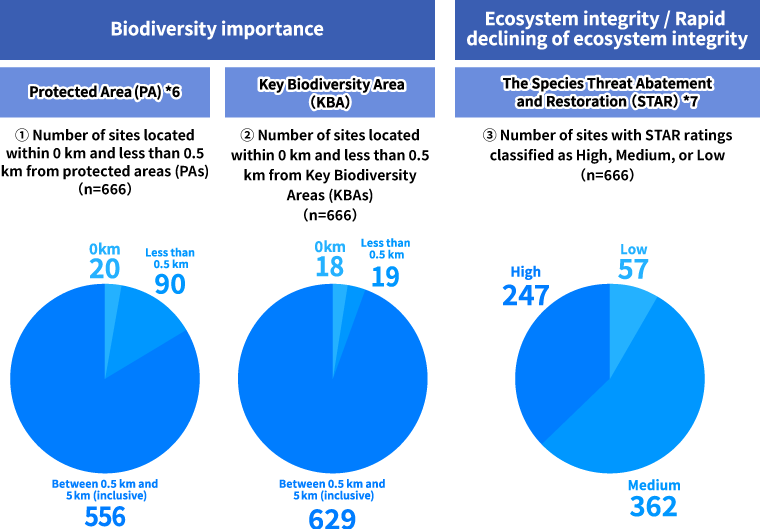
*5 IBAT:a biodiversity risk analysis tool provided by the IBAT Alliance, involving organizations such as the United Nations Environment Program (UNEP).
*6 PA: among the protected areas identified by IBAT, certain categories--such as common fishery right areas, special green conservation districts, suburban special green conservation districts, and greening areas--were excluded from the scope of analysis, as their conservation objectives and regulatory characteristics were deemed to have limited relevance to the assessment of nature-related issues associated with retail store operations.
*7 STAR:the Species Threat Abatement and Restoration. A metric that quantifies the potential contribution of threat abatement and restoration activities to reducing global species extinction risk.
Based on the above assessment of dependencies and impacts, the direct dependencies and impacts on nature capital associated with current retail store operations are assessed as relatively limited. However, given the importance of proximity to areas of significance for biodiversity conservation, a screening of sites was conducted based on the distance from each store to Protected Areas (PA) and Key Biodiversity Areas (KBA). As a result, 30 locations with 0 km proximity to either a PA or KBA were identified as sites requiring further review (hereinafter referred to as "priority sites"). In addition, 4 locations (two in Fukuoka Prefecture, one in Aichi Prefecture, and one in Aomori Prefecture) with 0 km proximity to both a PA and a KBA were identified as sites requiring management attention (hereinafter referred to as "key sites").
For these key sites, a detailed desktop review was conducted, including an assessment of the characteristics of the relevant PA and KBA, as well as major species inhabiting the surrounding areas. The results confirmed that no significant impacts on nature or biodiversity attributable to current store operations have been identified, and that nature-related risks associated with the locations of these key sites are not considered significant at present.
While the dependencies and impacts on nature capital associated with retail store operations are assessed as relatively limited, due consideration will be given to the surrounding natural environment when establishing new stores or when operational changes occur at priority or key sites. Ongoing information gathering and monitoring of environmental conditions at these locations will also be conducted.
■ Dependencies and impacts across the product value chains
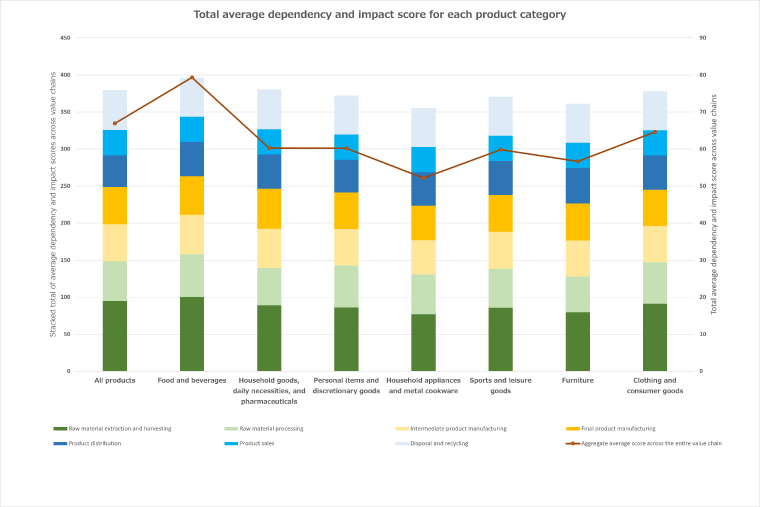
Seven product categories were assessed for the product value chain. Based on the ENCORE assessment results, scores were assigned to each stage of the value chain--from raw material sourcing to manufacturing, distribution, sales, disposal, and recycling. These scores were then averaged and aggregated by product category to derive an overall assessment. As a result, among the seven product categories, the overall average value chain score was highest for "Food and Beverages," followed by "Apparel and Household Goods (Textiles)." In addition, across all seven product categories, the "raw material extraction and harvesting" stage consistently showed the highest average score within the value chain.
Additionally, we conducted a more detailed analysis of the drivers of nature-related dependencies and impacts at this upstream stage. Based on these findings, we identified nature-related risks and opportunities associated with raw material sourcing, taking into account the characteristics of each product category. These insights form an important basis for the PPIH Group's future response strategies.
| Ecosystem services / Impact driver categories | Operational risk factors | Food and beverages | Household goods, daily necessities, and pharmaceuticals | Personal items and discretionary goods | Household appliances and metal cookware | Sports and leisure goods | Furniture | Clothing and consumer goods | |
|---|---|---|---|---|---|---|---|---|---|
| Dependencies | Provisioning services | Use of agricultural, forestry, and fishery products as raw materials | ● | ● | ● | ● | ● | ● | |
| Regulating and maintenance services | Production of agricultural, forestry, and fishery products in environments with suitable conditions, including soil quality, water availability, precipitation levels, and other climatic factors | ● | ● | ● | ● | ● | ● | ||
| Use of water meeting specified quality standards in quarrying and coal mining processes (e.g., cooling and chemical treatment) | ● | ● | |||||||
| Impacts | Climate change | GHG emissions (particularly methane) from the digestive processes of ruminant livestock (especially cattle and sheep) and from manure in livestock production | ● | ● | ● | ||||
| GHG emissions associated with energy use in mineral extraction and quarrying processes | ● | ● | ● | ● | ● | ● | |||
| Land / freshwater / ocean use change | Land conversion associated with livestock farming, afforestation, and crop cultivation (particularly SBTN High Impact Commodity List items such as cattle, coffee, soy, rubber, and cocoa), as well as the establishment of aquaculture facilities | ● | ● | ● | ● | ||||
| Installation of drainage systems, settling ponds, and treatment facilities for mineral extraction and non-ferrous metal mining, as well as the use of freshwater bodies in quarrying operations | ● | ● | ● | ● | ● | ● | |||
| Removal of the seabed surface layer through mineral extraction, drilling, suction, stripping, and quarrying activities | ● | ● | ● | ● | ● | ● | |||
|
Pollution (air quality) |
Emission of waste in livestock farming (e.g., ammonia and odorous substances from manure) and the intensive application of fertilizers and pesticides in crop cultivation (particularly cereals, legumes, and oil crops) | ● | ● | ● | |||||
| Releases of dust, exhaust gases from fuel combustion (e.g., NOx, SOx), and volatile organic compounds across processes such as extraction, recovery, excavation, crushing, and beneficiation of minerals, non-ferrous metals, stone, and sand | ● | ● | ● | ● | ● | ● | |||
|
Pollution (waste) |
Generation of waste, including manure, residues, and material waste (e.g., plastic inputs), in livestock farming, crop cultivation (particularly perennial crops, cereals, legumes, and oil crops), and aquaculture | ● | ● | ● | ● | ||||
| Generation of mineral residues and by-products (e.g., tailings and slag) associated with mining and beneficiation processes in the non-ferrous metal industry | ● | ● | ● | ● | ● | ● | |||
|
Pollution (soil and water) |
Use of feed and fertilizers in livestock farming, crop cultivation, and aquaculture | ● | ● | ● | ● | ||||
| Use of agrochemicals in crop cultivation, and the use of antibiotics and other chemical substances for disease prevention and health management in livestock farming and aquaculture | ● | ● | ● | ● | |||||
| Generation of wastewater containing chemical substances, as well as mining waste (overburden) and residues in mining and quarrying activities | ● | ● | ● | ● | ● | ● | |||
|
Pollution (local nuisances) |
Generation of noise, vibration, and light pollution arising from heavy machinery operation and nighttime lighting use in mining and quarrying activities | ● | ● | ● | ● | ● | ● | ||
|
Resource use and replenishment (water) |
Use of water for drinking and hygiene management in livestock farming, water quality management in aquaculture, and irrigation water use in crop cultivation (particularly cereals, legumes, and oil crops) | ● | ● | ● | |||||
|
Resource use and replenishment (biotic resources) |
Collection of wild species associated with aquaculture feed and the sourcing of juvenile fish | ● | |||||||
|
Resource use and replenishment (other abiotic resources) |
Extraction of non-living resources, including mineral resources, stone, sand, and clay, in mining and quarrying operations | ● | ● | ● | ● | ● | |||
| Invasive species | Spread of invasive alien species through pathways such as the contamination of feed and bedding with non-native plant seeds, unintentional seed transport during livestock movement, inadequate waste management in crop cultivation, attachment of invasive species to agricultural machinery and workers' clothing, and the escape of aquaculture species | ● | ● | ● |
Based on the above analysis, raw material sourcing in the upstream product value chain is recognized as a critical area closely linked to the PPIH Group's nature-related risks and opportunities and is therefore of fundamental importance in shaping future management responses.
Nature-related risks and opportunities
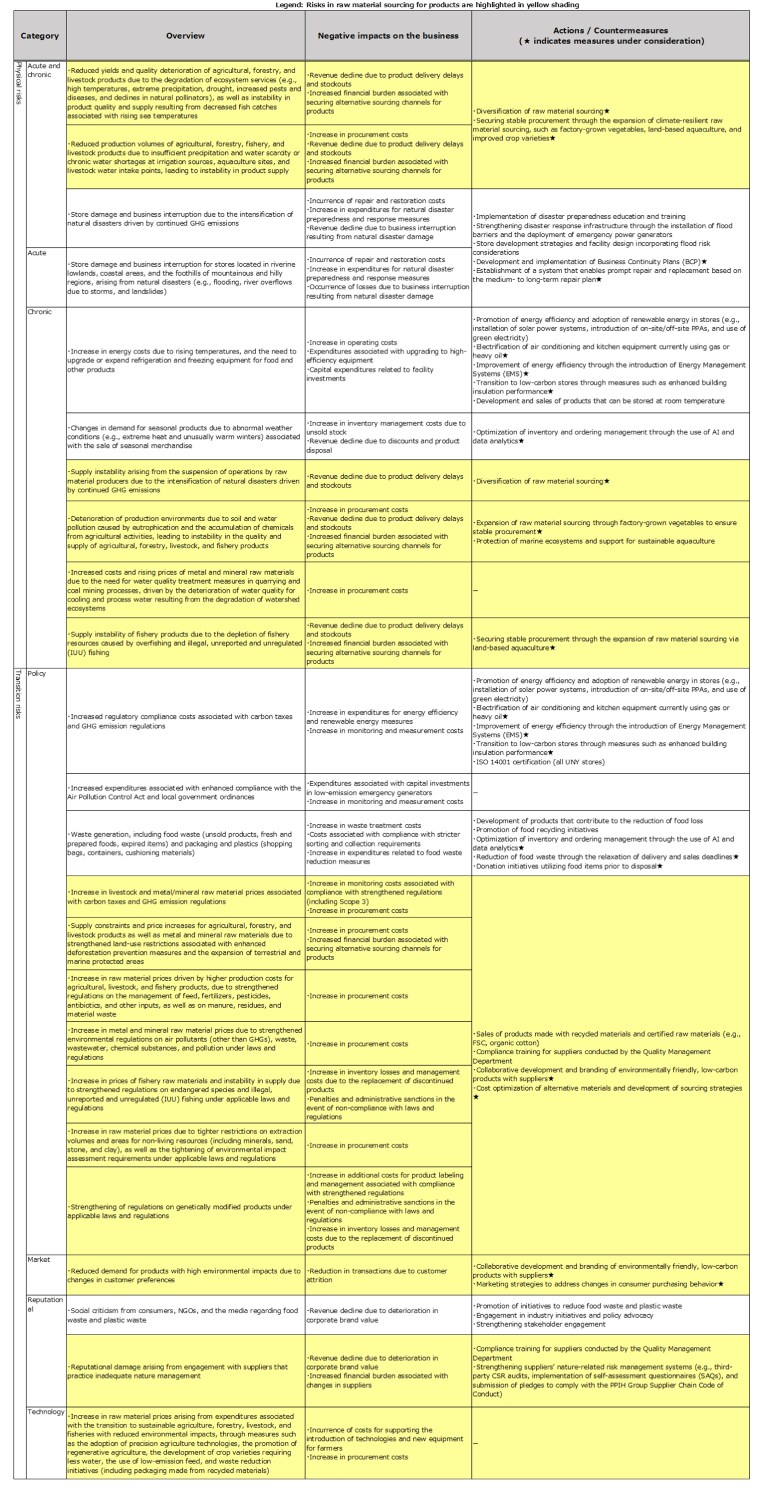
Based on the assessment of nature-related dependencies and impacts in both retail store operations and in the product value chains, the PPIH Group identified and assessed nature-related risks and opportunities within its domestic retail business. In parallel, we evaluated response measures for the identified risks and opportunities and assessed the potential negative and positive impacts of these risks and opportunities on our business.
1.Assessment results
■ Risks
■ Opportunities
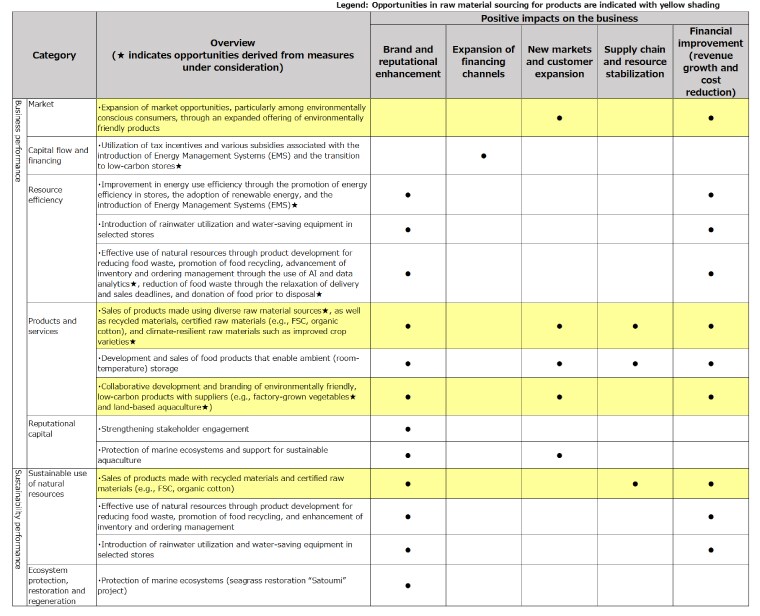
2.Corporate Strategy
Based on the assessments of dependencies and impacts, as well as analyses of nature-related risks and opportunities in line with TNFD, the PPIH Group recognizes the management of nature-related issues as an important consideration in our medium- to long-term business operations. In direct operations, including retail store operations, we promote initiatives to reduce environmental impacts associated with energy use, and also resource circulation. At the same time, across product value chains--particularly in upstream activities such as raw material sourcing in the food and beverage sector, where future business expansion is anticipated, including private brand/OEM products--we recognize the potential for nature-related risks arising from dependencies and impacts on nature capital. Further identification and assessment of these related issues are considered necessary.
In advancing these efforts, the PPIH Group recognizes the importance of conducting assessments that take into account the characteristics of raw material production processes and sourcing regions. We will progressively enhance the granularity of analyses and expand the scope of assessment.
Through these initiatives, we are strengthening our understanding and management of nature-related issues and are working to integrate nature-related considerations into business operations and decision-making processes.
Risk and impact management
Process for identifying, assessing, and prioritizing nature-related issues
■ Determination of the scope of assessment
For this disclosure, the domestic retail business--one of the PPIH Group's core businesses--has been selected from its diverse operations as the scope of assessment. The value chain of the domestic retail business spans activities from raw material sourcing and logistics to store operations, the provision of products and services, and disposing and recycling. To capture the interfaces with nature across these activities, the scope of assessment includes the following:
- ・Retail store operations: direct operational activities across all 666 stores in Japan, including consideration of the surrounding natural environment
- ・Product value chains: value chains of key products sold in domestic stores
■ Assessment process for dependencies, impacts, risks, and opportunities
Based on the scope defined above, we conducted an assessment using the TNFD-recommended LEAP approach to identify and evaluate dependencies and impacts on nature, as well as the associated risks and opportunities.
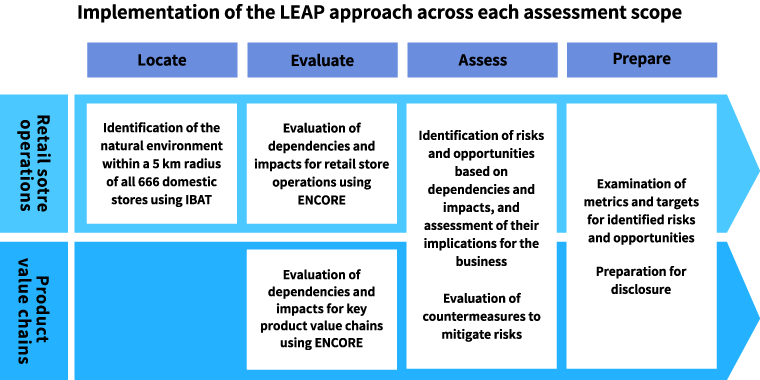
Using IBAT, the PPIH Group conducted a location-specific analysis of the natural environment within a 5 km radius of all 666 retail store locations in Japan. The analysis considered three criteria: biodiversity importance, ecosystem integrity, and rapidly declining ecosystem integrity. Given that retail store operations do not involve significant water abstraction or direct discharge into rivers or other water bodies, "physical water risk" was excluded from the assessment criteria. Specifically, the analysis was conducted using Protected Areas (PA), Key Biodiversity Areas (KBA), and the Species Threat Abatement and Restoration (STAR) metric as key indicators. Locations with 0 km to either a PA or KBA were identified as sites requiring further review (hereinafter referred to as "priority sites"), and locations with 0 km to both PA and KBA were designated as sites of management importance (hereinafter referred to as "key sites") (*).
For these key sites, in addition to the initial analysis conducted using IBAT, a detailed desktop assessment was carried out utilizing the Environmental Impact Assessment Database System (EADAS) *8 provided by the Ministry of the Environment, Japan, as well as publicly available information on the natural environment and biodiversity from relevant local authorities. This analysis covered the characteristics of the relevant PAs and KBAs, as well as major species inhabiting the surrounding areas.
*8 EADAS: Environmental Impact Assessment Database System. A database provided by the Ministry of the Environment, Japan, that supports environmental impact assessments by enabling centralized access to information on the natural environment across Japan, including data on natural parks, wildlife protection areas, vegetation, and the distribution of material species.
(*)Among the Protected Areas (PA) identified by IBAT, certain categories--such as common fishery right areas, special green conservation districts, suburban special green conservation districts, and greening areas--were excluded from the scope of analysis, as their conservation objectives and regulatory characteristics were deemed to have limited relevance to the assessment of nature-related issues associated with retail store operations.
The PPIH Group evaluated dependencies on and impacts on nature using ENCORE. For retail store operations, the sector classification "non-specialized retail trade" was applied.
For product value chains, key products were classified into seven categories and 34 groups based on raw material characteristics and manufacturing processes. For each product category, the entire value chain, from raw material sourcing to manufacturing, distribution, sales, and end-of-life treatment (disposal and recycling), was mapped and relevant sectors were identified. ENCORE assessments were then conducted for each sectors.
Based on the results, dependencies and impacts on nature were analyzed across both retail store operations and product value chains.
Based on the ENCORE assessment results, the PPIH Group identified priority operational risk drivers and conducted further assessment of nature-related risks and opportunities in line with TNFD categories.
For retail store operations, risks and opportunities were identified based on dependencies and impacts rated as Medium or above in the ENCORE assessment, added with the consideration of business materiality and stakeholder interest. For product value chains, the assessment focused on upstream activities, particularly raw material extraction and harvesting, where the scores for dependency and impact were highest. Risks and opportunities were identified for items that showed assessment results as High or above.
The PPIH Group assessed the potential negative and positive impacts of identified risks and opportunities on its business, and evaluated countermeasures to mitigate risks and capturing opportunities.
For identified risks and opportunities, the PPIH Group examined relevant metrics and targets for monitoring and management and advanced preparations for disclosure.
Management processes for nature-related issues and integration into organization's overall risk management
In the PPIH Group, the Compliance Promotion Headquarters manages risk incidents that occur mainly at stores and other business locations. Information relating to risk incidents is collected, and risk responses and countermeasures are determined in coordination with relevant departments. Stores and business locations implement these measures based on such guidance and instructions.
For climate change-related risks, the Sustainability Committee identifies and evaluates risks, considers and promotes countermeasures, conducts management activities, and shares information with the Compliance Promotion Headquarters.
The PPIH Group is also considering integrating nature-related risks beyond climate change into its enterprise-wide risk management framework in the same manner.
Metrics and Targets
The PPIH Group has established the following metrics in relation to nature-related issues.
| Driver of nature change | Metric no. | Indicator | The PPIH Group's results (Actual results for FY2024 and FY2025, or links to relevant data) | Target | Connection to GBF targets | Linkage to risks and opportunities |
|---|---|---|---|---|---|---|
| Climate Change | - | GHG emissions | Scope 1, 2 and 3 GHG emissions (t-CO₂) (Scope: major domestic entities) FY2024 Actual: 6,584,624 FY2025 Actual: 6,978,516 Note: Scope 2 emissions used in the total are calculated based on the market-based method. |
|
7 | |
| Pollution / Pollution removal | C2.1 | Wastewater discharged | Wastewater discharge volume (thousand m³) (Scope: UNY Co., Ltd. and UD Retail Co., Ltd.) FY2024 Actual: 3,477 FY2025 Actual: 3,648 |
No specific targets have been established. | 7, 11 | |
| C2.2 | Waste generation and disposal | Waste generation (t) (Scope: domestic retail entities) FY2024 Actual: 152,438 FY2025 Actual: 151,781 |
No specific targets have been established. | ● | ||
| Recycling volume (t) (Scope: domestic retail entities) FY2024 Actual: 92,975 FY2025 Actual: 96,026 |
||||||
| C2.3 | Plastic pollution | Plastic use in customer services (Scope: domestic retail entities)※ Shopping bags, laminated films for in-store POP displays, plastic food bags, cutlery (spoons and straws), and umbrella bags FY2024 Actual: 2,653 FY2025 Actual: 2,586 |
Reduce plastic use in customer services by 70% by 2030 compared to FY2019 levels. | ● | ||
| Risks and Opportunities | C7.2 | Description and value of significant fines/penalties received/litigation action in the year due to negative nature-related impacts | Fines for non-compliance with environmental laws and regulations (JPY) (Scope: major domestic entities) FY2024 Actual: 0 FY2025 Actual: 0 |
● |
| Sector | Metric no. | Indicator | The PPIH Group's results (Actual results for FY2024 and FY2025, or links to relevant data) | Target | Linkage to risks and opportunities |
|---|---|---|---|---|---|
| Beverages | B.C3.1 | Water use | Water use (thousand m³) (Scope: UNY and UDR) FY2024 Actual: 2,828 FY2025 Actual: 2,827 |
No specific targets have been established. | |
| Food and agriculture | FA.C23.0 | Food waste repurposed | Food waste generation (t) (Scope: domestic retail entities) FY2024 Actual: 16,086 FY2025 Actual: 15,397 |
No specific targets have been established. | ● |
| Food waste recycled (t) (Scope: domestic retail entities) FY2024 Actual: 9,503 FY2025 Actual: 8,867 |