

- HOME
- Sustainability
- Materiality 1
Reduce the environmental impact of our business activities - Climate change (information disclosure based on TCFD recommendations)
Climate change (information disclosure based on TCFD recommendations)
Information disclosure based on TCFD recommendations in Japan

We recognize that addressing climate change is a material issue for the PPIH Group's sustainable development as well as the enhancement of corporate value over the medium to long term. In order to accelerate and ensure our efforts, we endorsed the Task Force on Climate-related Financial Disclosures("TCFD")in February of 2022 and conducted scenario analysis and disclosure based on the TCFD framework. We will continue with our efforts to address climate change and expand disclosures.
Governance
The Sustainability Committee, under the leadership of the Director, Managing Executive Officer and CAO, who is the officer in charge of sustainability, plans and formulates countermeasures and reflects them in the business activities of Group companies.
The Sustainability Committee reports to the Board of Directors at least once a year on the progress of sustainability initiatives, including climate change, and the status of achieving targets. Policies, strategies, and important initiatives related to climate change are discussed and approved by the Board of Directors to implement sustainability measures.
The Sustainability Committee is chaired by the Executive Officer and the Head of IR Headquarters, meets once a month. We receive reports from subcommittees of sub-organizations on our responses to sustainability issues, including climate change, and set targets, manage progress, and monitor them. In addition, we hold regular meetings with outside committee members with specialized knowledge in sustainability management to build a system that allows them to work from a professional perspective.
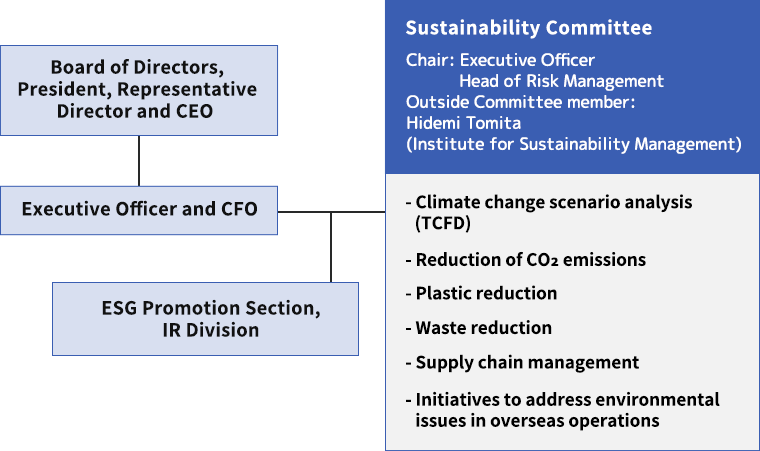
Governance Structure and Roles Related to Climate Change (FY ending June 2026)
| Organization | Member | Role | Number of Reports and Events |
Fiscal year ending June 26 Main Reports and Deliberations |
|---|---|---|---|---|
| Board of directors |
Director Auditor |
|
Twice a year |
|
| Sustainability Committee |
[Chair] Executive Officer and Head of IR Headquarters [Members] Heads of Related Departments (Environmental Measures, Design, Facility Management, Disaster Countermeasures, Crisis Management, Store Compliance, Product Procurement Department, Quality Control, Fair Trade Management, Legal Affairs, Merchandising) [Outside Members] Hidemi Tomita (Representative Director, Sustainability Management Research Institute) |
|
12 times a year (1 time per month) |
|

Strategy: Scope of analysis
[1.5°C and 4°C scenarios]
According to the Intergovernmental Panel on Climate Change (IPCC) Sixth Assessment Report (AR6), the change in global average temperature until 2100 is divided into five scenarios by increasing or decreasing CO₂ emissions.
In addition, various institutions and organizations have published multiple scenarios, but we conducted a scenario analysis based on the 1.5°C and 4°C climate scenarios because (1) it is not strategic to formulate countermeasures for all possible futures, and (2) it is easy to deal with the results of both ends when the results are between them.
| 1.5°C Scenario | 4°C Scenario | |
|---|---|---|
| Expected society | A society in which social changes associated with the transition to a decarbonized economy are likely to impact business operations, in order to limit the rise in global average temperature to 1.5°C by the end of this century |
|
| Referenced scenarios | IEA「World Energy Outlook 2024」Net Zero Emissions by 2050 Scenario |
|
Strategy: Identification of significant risks/opportunities
PPIH Group operates over 700 stores in Japan and overseas, procuring and selling a wide variety of products tailored to regional needs.
With over 80% of its sales generated domestically, the Group expects climate change to have a relatively greater impact on its domestic operations.
For this reason, the scope of scenario analysis was defined as "domestic store operations" and "product procurement."
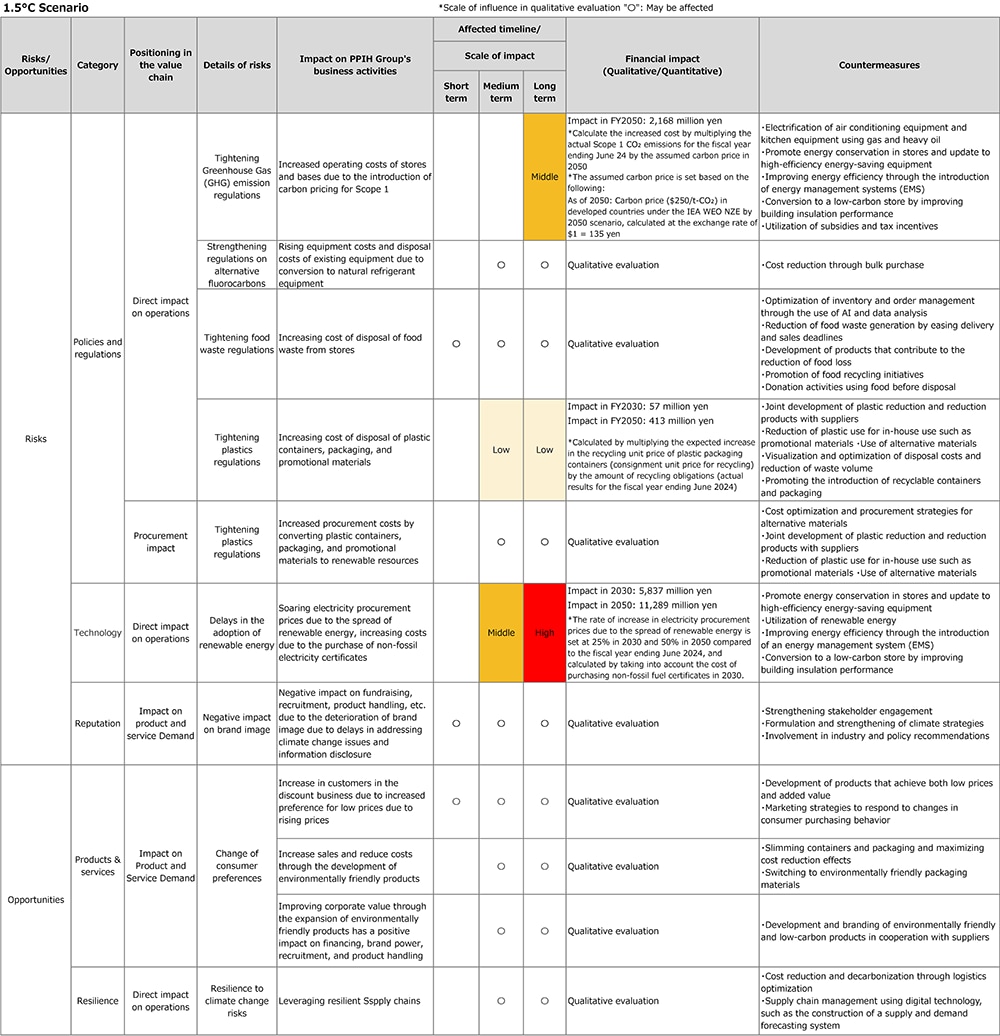
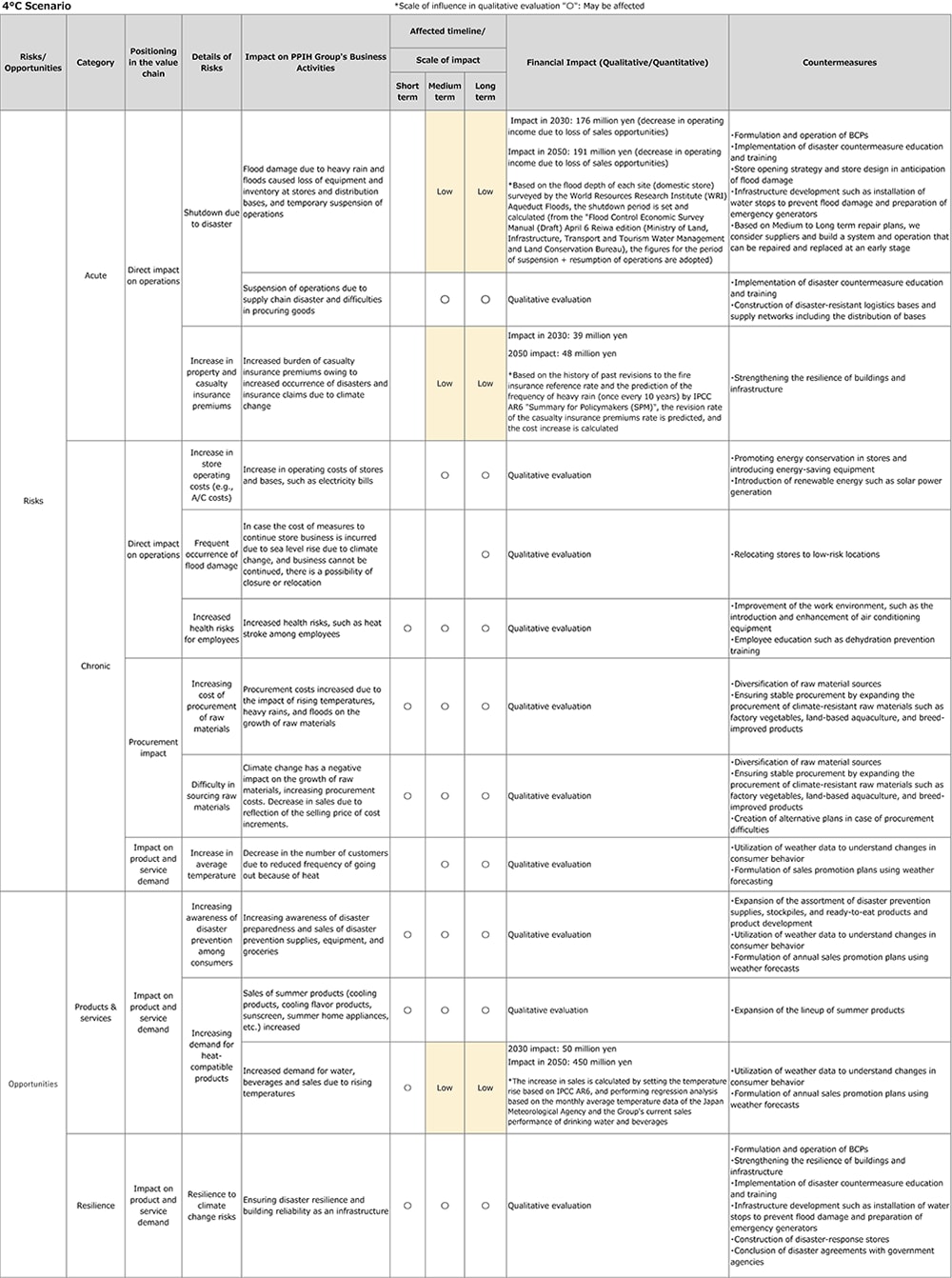
Based on the 1.5°C and 4°C climate scenarios, the Group identified risks and opportunities arising from climate-related changes in the social environment and evaluated the financial impact on its value chain processes across the short, the medium, and the long term timeframes. (Scenario analysis conducted in June 2025)
For the FY ending June 2026, we reviewed the validity of the underlying assumptions and concluded that there were no material changes.
To ensure business continuity and expand opportunities under either scenario, the Group will implement the following countermeasures and respond flexibly and promptly to changes in the social environment.
- *1 Timeframes are defined as: Short term: up to 1 year, Medium term: up to 2030, Long term: up to 2050.
- *2 Financial impact within the value chain was assessed qualitatively and quantitatively based on "likelihood × magnitude of impact." (Risks and opportunities that could not be quantified were evaluated qualitatively, with likelihood assessed for each timeframe.)
Quantified impacts were rated on a three-level scale as below:
Financial impact settings... High: 3% or more of consolidated operating profit, Medium: Less than 3% to 1%, Low: Less than 1%
■1.5℃ scenario
■4℃ Scenario
Risk management
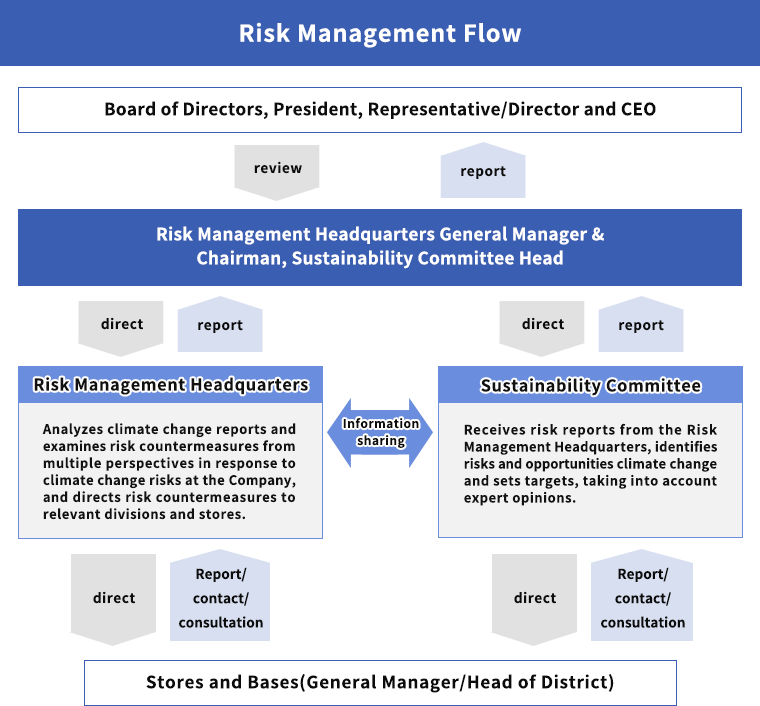
In the PPIH Group, the Compliance Promotion Headquarters manages risk incidents that occur mainly at stores and bases. Information collection, risk response, and countermeasures related to risk incidents are determined in cooperation with relevant departments, and stores and bases implement measures based on their instructions.
The Sustainability Committee identifies and evaluates climate change-related risks and opportunities, considers and promotes countermeasures, and manages them, and coordinates information with the Compliance Promotion Headquarters. We regularly monitor responses to risks, including those related to climate change, by conducting on-site inspections and other activities. The results are shared with relevant departments, and improvements are thoroughly implemented in collaboration with them. We also report significant risks to the Board of Directors as necessary.
■Details of the process of identifying and assessing risks related to climate change
The Sustainability Committee evaluates the degree of impact on the value chain process on three levels (high, medium, and low) for each 1.5°C scenario and 4℃ scenario based on the likelihood of impact and the magnitude of the impact, and plans, considers, and implements countermeasures. (See "Strategy" for details) Going forward, we will strengthen cooperation between the Compliance Promotion Headquarters and the Sustainability Committee to establish a system for recognizing and managing climate-related risks as company-wide management risks.
Metrics and targets
Recognizing that addressing climate change is an important issue for the sustainable development of the PPIH Group and the enhancement of corporate value over the medium to long term, we have set decarbonization targets with reference to Japan's NDC based on the Paris Agreement in order to respond to the risks related to CO₂ emissions identified through scenario analysis based on the TCFD framework.
The Group will work together to achieve its goals and regularly disclose progress. We will also consider countermeasures for other risks, formulate quantitative targets, and disclose initiatives to achieve them as needed, thereby promoting responses to climate change.
■PPIH Group Decarbonization Targets
| Objectives (Target: Domestic Scope 1 and 2) |
|---|
| 50% reduction of CO₂ emissions from stores by 2030(compared to FY2013) |
| Reduce the total amount of CO₂ emissions from stores to zero by 2050 |
-Main Initiatives to Achieve the Goals
- ➀Improve the efficiency of energy use and reduce energy consumption in store operations by introducing air conditioning, refrigeration and freezer case control equipment, dimming lighting equipment, and thoroughly optimizing the set temperature and lighting time.
- ➁Creation of renewable energy such as solar power generation
- ➂Replacing with renewable energy using non-fossil certificate trading
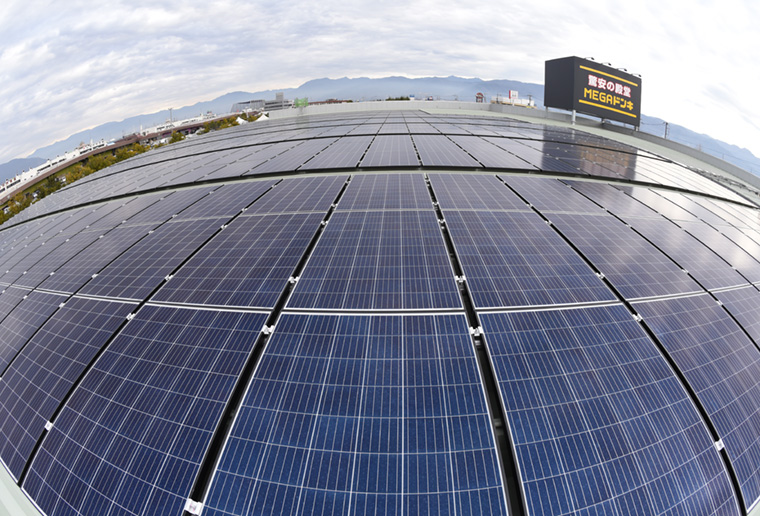
Solar panels (MEGA Don Quijote Kofu)
In the future, we will expand the scope of our scenario analysis to include categories other than food products and overseas businesses to identify risks and opportunities. We will also work with our suppliers to build an environmentally friendly supply chain and improve the accuracy of our disclosure of Scope3 emission reductions.
- *Scope 3:
- Greenhouse gas emissions from the manufacturing of goods purchased by the company and from the use of the company's products by consumers
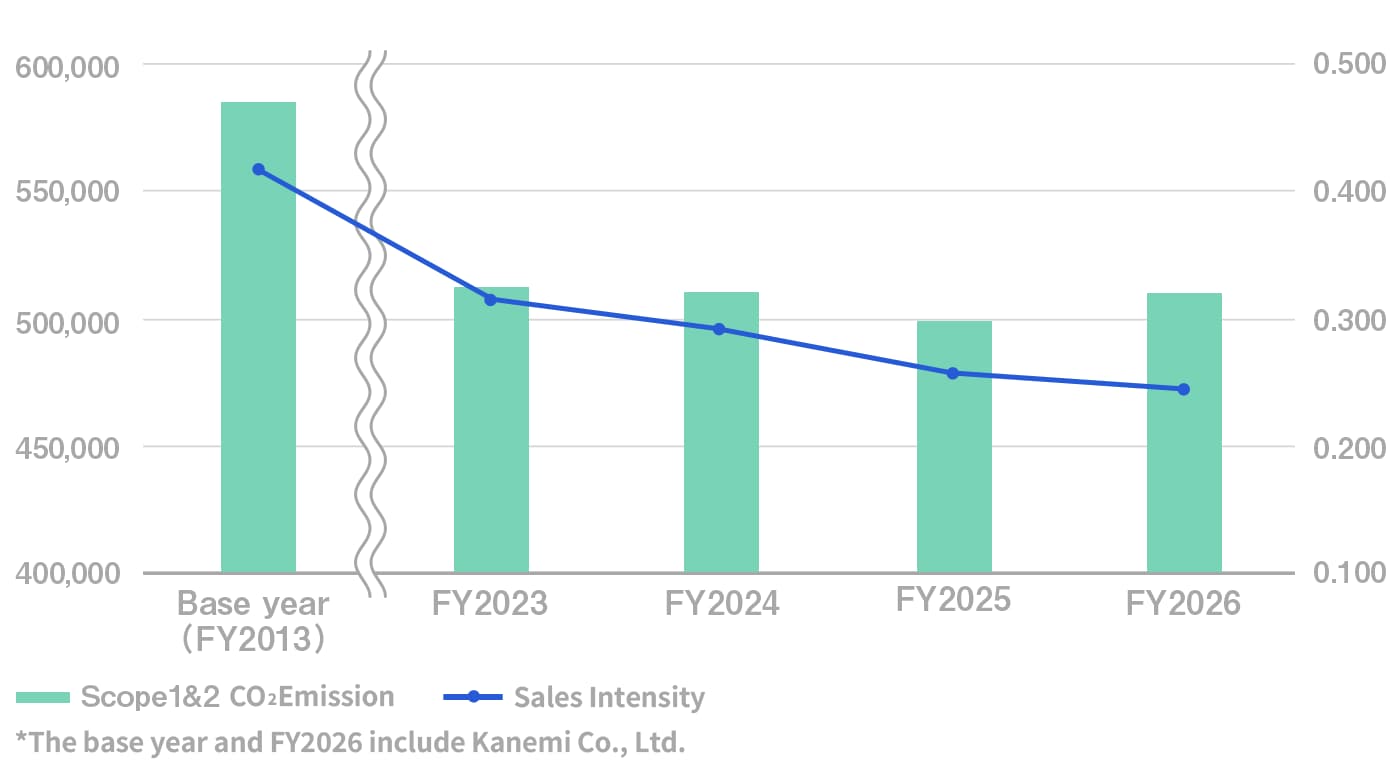
-Transition of CO₂ emissions and sales intensity
In the FY ending June 2026, CO₂ emissions intensity per unit of sales was reduced by 40.5% compared with FY2013, demonstrating steady progress toward our 2030 target of reducing CO₂ emissions from stores by 50% compared with FY2013.
| FY2022 | FY2023 | FY2024 | FY2025 | FY2026 | |
|---|---|---|---|---|---|
| CO₂ Emission Scope1 *1 *2 (t-CO₂) |
70,174 | 65,324 | 64,228 | 68,530 | 85,201 |
| CO₂ Emission Scope2 (market-based method) *1 *3 (t-CO₂) |
452,694 | 447,181 | 446,025 | 433,238 | 425,500 |
| CO₂ Emission Scope2 (location-based method) *4 (t-CO₂) |
488,265 | 467,149 | 464,994 | 466,661 | 468,842 |
| Total*5 | 522,868 | 512,505 | 510,253 | 501,768 | 510,701 |
| CO₂ EmissionsSales Intensity (Per million yen) |
0.336 | 0.319 | 0.296 | 0.269 | 0.248 |
| Progress Against Base Year (FY2013) | 16.0% reduction | 20.3% reduction | 26.0% reduction | 32.7% reduction | 40.5% reduction |
- *1 Scope 1 and 2 are calculated based on "the Act on the Rationalization of Energy Use and Conversion to Non-Fossil Energy" and "the Act on the Promotion of Global Warming Countermeasures"
- *2 Scope 1: Calculated using the emission factors in reference to "List of Calculation Methods and Emission Factors in the Calculation, Reporting, and Disclosure System" by the Ministry of the Environment
- *3 Scope 2 (market-based): Calculated using the emission factors published in the "Emission Factors by Electricity Utility (for Calculating Greenhouse Gas Emissions Reported by Specified Emitters)" issued by the Ministry of the Environment and the Ministry of Economy, Trade and Industry.
- *4 Scope 2 (location-based): Calculated using the "substitute value" provided in the "Emission Factors by Electricity Utility (for Calculating Greenhouse Gas Emissions Reported by Specified Emitters)" published by the Ministry of the Environment and the Ministry of Economy, Trade and Industry.
- *5 Scope 2 emissions used for the total emissions and CO₂ emissions intensity per unit of sales are calculated on a market-based basis.
CO₂ Emissions and Sales Intensity Trends
Climate change (information disclosure based on TCFD recommendations in overseas) -Gelson's
Gelson's recognizes addressing climate change as a key issue for enhancing corporate value and achieving sustainable growth in the medium to long term. Gelson's is committed to promoting climate scenario analysis and the disclosure of related information in accordance with the recommendations of the Task Force on Climate-related Financial Disclosures (TCFD). The commitment is aligned with the policy of parent company, PPIH, which endorses the recommendations of TCFD. As a member of PPIH Group, Gelson's will continue to strengthen our efforts to address climate change, aiming for a sustainable society, while enhancing corporate value. Based on the Recommendations of TCFD, we will disclose climate-related information as follows.
Governance
At Gelson's, we are developing a governance structure aligned with the policies of the PPIH Group, to promote sustainability management, including response to climate change.
We are building our governance structure in collaboration with officers working on sustainability, legal and risk management.
From a global governance perspective, the Sustainability Committee at PPIH reports the group's overall policies, strategies, and key activities to the Board of Directors approximately twice a year, sharing the activities and challenges of subsidiaries, including Gelson's.
Additionally, a director of PPIH participates in Board of Directors meeting of Gelson's (held monthly), establishing a framework for the group to discuss and make decisions on important matters related to climate change, including risks and response measures.
Strategy
■Scenario Analysis
According to the Intergovernmental Panel on Climate Change (IPCC) Sixth Assessment Report (AR6), changes in the global average temperature by 2100 are presented in five scenarios based on variations in CO₂ emissions.
Although some organizations have published multiple scenarios, we find that it is not practical to prepare measures for all possible futures. By focusing on both extreme scenarios, it becomes easier to respond when actual outcomes fall in between. Therefore, we conducted scenario analyses based on the 1.5 ℃ and 4 ℃ climate scenarios. (Timing of scenario analysis: October 2025)
| 1.5°C Scenario | 4°C Scenario | |
|---|---|---|
| Imagined Society | A society where, to limit the rise in global average temperature to 1.5℃ by the end of this century, the transition to a decarbonized society is likely to cause social changes that significantly impact business. | A society where, despite the implementation by various governments based on the Paris Agreement, the global average temperature rises by the end of this century, and climate change is likely to significantly impact business. |
| Reference Scenario |
|
|
Since all Gelson's stores are located in California and we procure and sell groceries to local consumers, thus the analysis focuses on North America area. The entire value chain is included in the analysis, assessing impacts not only on the stores and facilities but also on products, suppliers, and customers. The timeframes for the analysis are categorized as short-term (0-5 years), medium-term (5-10 years), and long-term (10-30 years), with impacts evaluated for each timeframe.
In conducting the scenario analysis, we organized the expected changes in social environments and stakeholders for each scenario as "Scenario Worldviews". The table below summarizes the scenario worldviews as of 2035.
| Category | 1.5°C Scenario | 4°C Scenario |
|---|---|---|
| Policy / Regulation |
|
|
| Investors / Financial Institutions |
|
|
| Technology |
|
|
| Natural Environment |
|
|
| Suppliers |
|
|
| Customers / Market |
|
|
■Identification of Risks and Opportunities
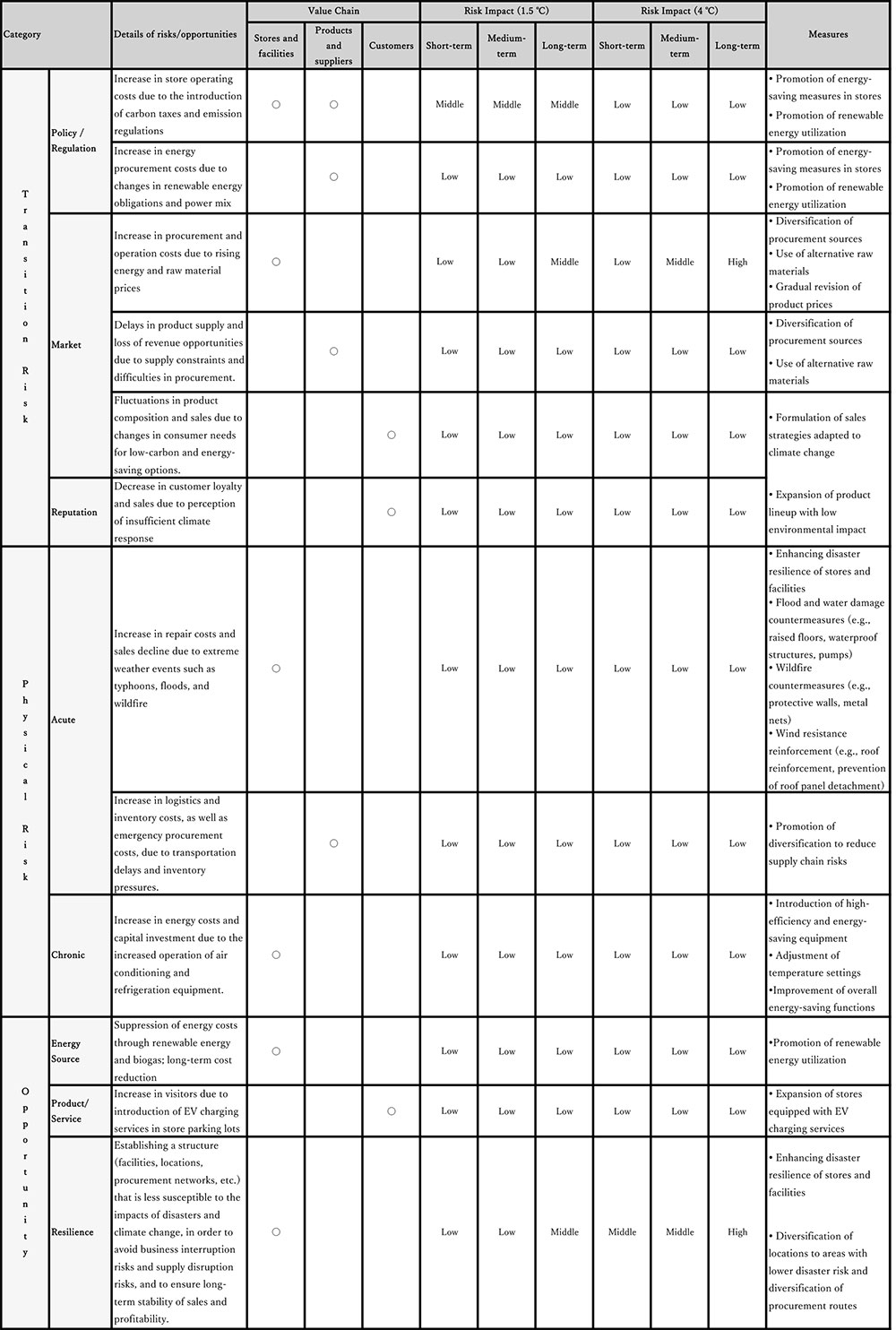
Based on the expected changes in social environments due to climate change in the 1.5 ℃ and 4 ℃ scenarios, we identified climate-related risks and opportunities. We also assessed the financial impact on our value chain across short, medium, and long-term timeframes. The financial impact was qualitatively assessed in three levels: "High", "Medium" , and "Low" defined as follows after quantitative evaluations for each timeframe.
"High": 2% or more,
"Medium": 1% to less than 2% of PPIH's consolidated operating profit,
"Low": less than 1% of PPIH's consolidated operating profit.
Moving forward, we will consider and implement the following measures to ensure business continuity toward either scenario and expand business opportunities, responding effectively and swiftly to changes in social environments.
Risk Management
Gelson's is currently in the process of establishing a climate-related risk management system. Moving forward, PPIH plans to incorporate climate-related risk management into its Business Continuity Plan (BCP) as part of our overall risk management strategy for large-scale disaster occurrences.
Metrics and Targets
Our commitment to addressing climate change is recognized as a critical issue for sustainable development and medium- to long-term enhancement of corporate value within the PPIH Group. We have positioned the following metric as key indicators as a member of PPIH Group:
・Sales of environmentally friendly products (brands)
This metric serves to quantitatively understand our response to climate change. We will continue to promote our response to climate change using this metric.